
High-Fidelity PCR has become a core molecular biology technique in laboratories where sequence accuracy, reproducibility, and downstream compatibility are essential. As experimental pipelines increasingly rely on cloning, next-generation sequencing (NGS), synthetic biology, and genome engineering, conventional PCR enzymes no longer meet the accuracy requirements demanded by modern workflows.
Unlike routine PCR—where yield and speed may be prioritized—High-Fidelity PCR emphasizes correctness. Even a single base substitution introduced during amplification can compromise cloning efficiency, alter protein function, or generate misleading sequencing data. This makes high-fidelity amplification a quality-control step, not merely an amplification step.
For foundational PCR concepts, the National Center for Biotechnology Information (NCBI) provides a comprehensive overview:
https://www.ncbi.nlm.nih.gov/probe/docs/techpcr/
https://www.ncbi.nlm.nih.gov/books/NBK589663/

Molecular Basis of Fidelity in DNA Polymerases
Proofreading Exonuclease Activity
The defining feature of high-fidelity DNA polymerases is 3′→5′ exonuclease proofreading activity. During nucleotide incorporation, if an incorrect base is added, the polymerase pauses, excises the mismatched nucleotide, and resumes synthesis with the correct base.
This mechanism dramatically reduces:
-
Base substitutions
-
Frameshift mutations
-
Accumulated sequence drift across cycles
A detailed biochemical discussion of proofreading activity can be found in this NIH-hosted review:
https://pmc.ncbi.nlm.nih.gov/articles/PMC2685094/
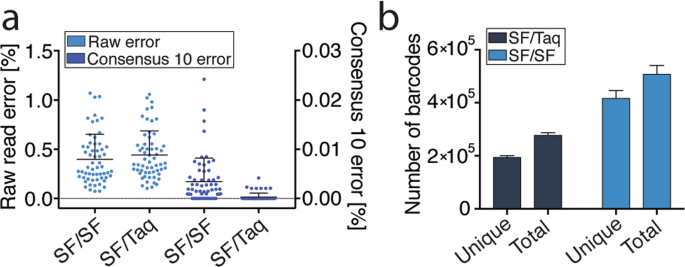
Error Rate Comparison
| Polymerase Type | Approximate Error Rate |
|---|---|
| Standard Taq | ~1 × 10⁻⁴ – 10⁻⁵ |
| High-Fidelity | ~1 × 10⁻⁶ – 10⁻⁷ |
Classic fidelity measurements and experimental comparisons are discussed in PubMed literature:
https://pubmed.ncbi.nlm.nih.gov/1842916/
This order-of-magnitude difference is critical when amplifying long fragments or templates destined for sequencing.
Why High-Fidelity PCR Is Essential in Modern Workflows
1. Gene Cloning and Expression Vector Construction
When PCR products are cloned into plasmids:
-
Any nucleotide error becomes a permanent part of the construct
-
Screening time increases dramatically
-
Protein expression may be altered or abolished
Many university cloning manuals explicitly recommend proofreading polymerases for insert generation:
https://yen.fccc.edu/docs/pentr_dtopo_man.pdf
https://openwetware.org/wiki/Gibson_Assembly
Next-Generation Sequencing (NGS) Library Preparation
PCR errors introduced before sequencing:
-
Appear as false variants
-
Inflate diversity estimates
-
Reduce confidence in low-frequency mutation detection
NIH-hosted resources on PCR bias and sequencing artifacts highlight the importance of enzyme choice:
https://www.ncbi.nlm.nih.gov/pmc/articles/PMC5428825/
https://www.ncbi.nlm.nih.gov/pmc/articles/PMC6517913/
Long-Range and GC-Rich Template Amplification
High-fidelity PCR systems are widely used for:
-
Long genomic regions (>5 kb)
-
GC-rich promoters
-
Repetitive or structured DNA
University protocol references include:
https://web.as.uky.edu/biology/faculty/mirabito/BIO%20510%20Fall%202007/Expand%20Long%20Template.pdf
https://openwetware.org/wiki/Long-range_PCR
Site-Directed Mutagenesis and Synthetic Biology
When introducing intentional mutations, background errors are undesirable. High-fidelity PCR ensures:
-
Only the designed mutation is present
-
Reduced off-target sequence noise
-
Higher success rates in downstream validation
Educational mutagenesis resources:
https://www.addgene.org/protocols/quickchange-mutagenesis/
https://openwetware.org/wiki/Site-directed_mutagenesis
Primer Design: A Major Determinant of High-Fidelity Success

Even the best polymerase cannot compensate for poor primer design.
Key Design Parameters (University-Backed)
-
Length: 18–24 nucleotides
-
GC content: 40–60%
-
Minimal secondary structure
-
Balanced melting temperatures (Tm)
Authoritative academic primer design resources:
-
https://dnacore.mgh.harvard.edu/new-cgi-bin/site/pages/sequencing_pages/primer_design.jsp
-
https://fire.biol.wwu.edu/cmoyer/zztemp_fire/biol324_W08/PCR_lect/GoodPCRdesign.pdf
Cycling Conditions Optimized for High-Fidelity PCR
Critical Parameters
| Parameter | Recommendation |
|---|---|
| Annealing temperature | Use calculated Tm, often higher than standard PCR |
| Extension time | Match polymerase speed and fragment length |
| Cycle number | Minimize (typically 25–30 cycles) |
| Hot-start | Strongly recommended |
Educational PCR optimization guides:
Common High-Fidelity PCR Pitfalls and Solutions
Nonspecific Amplification
-
Increase annealing temperature
-
Reduce primer concentration
-
Redesign primers with improved specificity
Low Yield
-
Extend elongation time
-
Increase template quality
-
Verify Mg²⁺ concentration
Primer Dimers
-
Avoid 3′ complementarity
-
Use hot-start protocols
-
Redesign primers if persistent
Troubleshooting references:
https://openwetware.org/wiki/PCR_troubleshooting
https://www.ncbi.nlm.nih.gov/pmc/articles/PMC4213345/
Quality Control and Standardization in PCR Workflows
High-fidelity PCR is commonly integrated into validated research pipelines, where consistency matters.
Recommended controls:
-
No-template controls (NTC)
-
Positive amplification controls
-
Replicate reactions
-
Reference materials
NIST provides DNA reference materials used in PCR-based assays:
These resources highlight how PCR accuracy is central to reproducibility in molecular biology.
Where High-Fidelity PCR Delivers the Most Value
High-Fidelity PCR is particularly suited for:
-
Cloning and plasmid construction
-
Amplicon sequencing
-
Synthetic biology
-
CRISPR donor preparation
-
Long-range PCR
-
Variant confirmation
It is not simply a premium alternative—it is a risk-reduction strategy for experiments where errors are costly.
Product Integration: High-Fidelity PCR for Reliable, Sequence-Accurate Amplification
A dedicated High-Fidelity PCR solution supports laboratories seeking:
-
Reduced mutation rates
-
Cleaner amplification profiles
-
Faster downstream validation
-
Improved reproducibility
By combining proofreading polymerase activity with optimized buffer systems, High-Fidelity PCR enables sequence-ready DNA amplification that integrates seamlessly into cloning, sequencing, and molecular engineering workflows.