
In modern molecular biology and genomics laboratories, capture probes play an essential role in the selective detection, enrichment, and analysis of nucleic acid sequences. Capture probe technology is widely used in hybridization-based workflows where specific DNA or RNA sequences are isolated from complex biological samples through complementary base pairing.
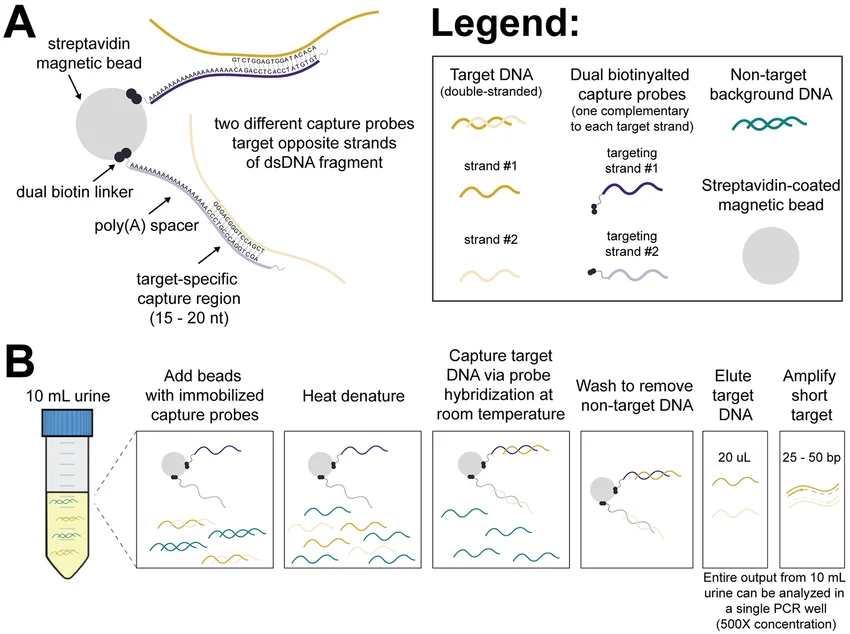
A capture probe is a short, synthetic nucleic acid sequence designed to hybridize with a complementary target region of DNA or RNA. Once the probe binds to the target sequence, the hybridized complex can be immobilized, isolated, and purified for downstream molecular analysis.
Capture probe strategies are used extensively in genomics research, transcriptomics, targeted sequencing, gene expression studies, and microbial genomic analysis. Educational explanations of nucleic acid hybridization and probe-based molecular techniques are available through the National Center for Biotechnology Information (https://www.ncbi.nlm.nih.gov) and the National Human Genome Research Institute (https://www.genome.gov), which describe the structural and biochemical principles governing nucleic acid interactions.
Understanding Capture Probe Technology
Capture probes operate on the fundamental principle of Watson–Crick base pairing, where complementary nucleotides within nucleic acid strands form stable duplex structures. When a probe sequence is designed to match a target region of interest, hybridization occurs under appropriate buffer conditions and temperatures.
Once hybridized, capture probes allow the target nucleic acid molecules to be selectively isolated from complex mixtures containing thousands of unrelated sequences. This selective enrichment enables researchers to focus on specific genomic regions or transcripts with improved analytical sensitivity.
Scientific discussions of nucleic acid base pairing and molecular hybridization mechanisms can be explored through educational materials provided by the National Institutes of Health (https://www.nih.gov), the National Institute of General Medical Sciences (https://www.nigms.nih.gov), and the National Library of Medicine (https://www.nlm.nih.gov).
Structure and Design of Capture Probes
The effectiveness of a capture probe largely depends on its sequence design and biochemical properties. Several parameters influence probe performance in hybridization experiments.
Probe Length
Capture probes typically range from 20 to 120 nucleotides, depending on the intended application. Longer probes often provide stronger hybridization stability, while shorter probes can offer higher specificity for single nucleotide variations.
Educational resources on probe design are available from the National Center for Biotechnology Information Primer-BLAST tool (https://www.ncbi.nlm.nih.gov/tools/primer-blast) and from the University of Utah Genetic Science Learning Center (https://learn.genetics.utah.edu).
GC Content
The proportion of guanine and cytosine bases within the probe sequence influences hybridization stability because GC base pairs form three hydrogen bonds compared to two in AT pairs.
Guidance on nucleic acid thermodynamics and GC content considerations can be found through the Massachusetts Institute of Technology OpenCourseWare molecular biology resources (https://ocw.mit.edu).
Melting Temperature (Tm)
Hybridization efficiency is influenced by the melting temperature of the probe-target duplex. Optimal hybridization conditions typically occur slightly below the melting temperature of the probe sequence.
Thermodynamic principles governing nucleic acid melting temperatures are described in educational resources from the National Institute of Standards and Technology (https://www.nist.gov) and the U.S. Department of Energy Joint Genome Institute (https://jgi.doe.gov).
Types of Capture Probes
Capture probes can be engineered in various formats depending on the experimental workflow and capture strategy.
Biotinylated Capture Probes
Biotinylated probes are frequently used in hybridization capture systems. After hybridization, the probe-target complexes can be immobilized using streptavidin-coated magnetic beads.
Biotin-streptavidin interactions are widely used in molecular biology and are described in biochemical tutorials from Cold Spring Harbor Laboratory (https://dnalc.cshl.edu).
RNA Capture Probes
RNA probes can also be used in hybridization capture experiments. These probes often exhibit strong hybridization efficiency due to the stability of RNA-DNA duplexes.
Educational discussions of RNA hybridization technologies are available from the University of California San Diego RNA Center (https://rna.ucsd.edu).
Tiled Capture Probes
In targeted genomic enrichment experiments, multiple probes may be designed to tile across a genomic region. This approach ensures comprehensive coverage of the region of interest.
Large-scale genomic enrichment methods are frequently used in sequencing workflows developed by the Broad Institute of MIT and Harvard (https://www.broadinstitute.org).

Applications of Capture Probes in Molecular Biology
Capture probes are used in numerous research applications involving nucleic acid analysis and genetic investigation.
Targeted Sequencing Enrichment
Capture probes enable selective enrichment of genomic regions before sequencing. This strategy reduces sequencing complexity and allows researchers to focus on specific genes or loci.
Targeted sequencing technologies are discussed in genomic research resources from the National Human Genome Research Institute
https://www.genome.gov.
Gene Expression Research
Capture probes can selectively isolate RNA transcripts, allowing researchers to analyze gene expression patterns within biological samples.
Transcriptomics research programs at institutions such as Stanford University (https://web.stanford.edu) and Harvard Medical School (https://genetics.med.harvard.edu) frequently use hybridization-based enrichment methods.
Microbial Genomics
Capture probe strategies can isolate microbial DNA sequences from complex environmental samples, enabling researchers to analyze microbial diversity and genomic variation.
Microbial genomics research is supported by programs such as the U.S. Department of Energy Genome Science Program
https://genomicscience.energy.gov.
Environmental DNA Studies
Capture probes can enrich genetic material from environmental samples including soil, water, and sediment. These techniques help researchers study biodiversity and ecological systems.
Environmental genomics research initiatives are described by the National Science Foundation Biological Sciences Directorate
https://www.nsf.gov/bio.
Factors Affecting Capture Probe Performance
Several experimental conditions influence capture probe hybridization efficiency.
Hybridization Temperature
Temperature must be carefully controlled to allow stable duplex formation without encouraging non-specific interactions.
Buffer Composition
Salt concentration and ionic strength affect nucleic acid duplex stability and hybridization kinetics.
Probe Specificity
Highly specific probe sequences reduce cross-hybridization and improve experimental accuracy.
Detailed discussions of nucleic acid hybridization conditions are available through educational resources from University of California Berkeley Molecular and Cell Biology Department
https://mcb.berkeley.edu.
Advantages of Capture Probe-Based Enrichment
Capture probe technologies provide several advantages in molecular biology workflows.
High sequence specificity
Complementary base pairing enables selective enrichment of target nucleic acids.
Improved analytical sensitivity
Capture enrichment increases the relative abundance of target sequences.
Compatibility with multiple analytical platforms
Captured nucleic acids can be analyzed through sequencing, amplification, or hybridization assays.
Scalability
Capture probe workflows can be adapted for both small research experiments and high-throughput genomic analysis.
Capture Probes in Modern Genomic Research
Hybridization capture techniques continue to play an important role in modern genomic research. By enabling selective isolation of DNA or RNA targets, capture probes allow scientists to investigate genetic variation, transcript expression, and microbial diversity with greater precision.
Advances in genomic technologies and sequencing platforms continue to expand the applications of capture probe-based enrichment systems. Educational resources discussing genomic research technologies can be explored through the National Institutes of Health Genomic Data Science Initiative
https://datascience.nih.gov.
Capture Probe
DNA Capture Probe
Hybridization Capture Probe
RNA Capture Probe
Targeted DNA Enrichment Probe
Nucleic Acid Capture Technology
Probe Hybridization System
Genomic Capture Probe
DNA Hybridization Probe
Targeted Sequencing Capture Probe