
Introduction
Infectious diseases continue to represent a major challenge to global health, requiring rapid, accurate diagnostic methods to ensure timely and appropriate treatment. Polymerase Chain Reaction (PCR) is widely regarded as one of the most effective and reliable methods for diagnosing infections. Infectious Disease PCR Quality Control ensures that PCR tests deliver accurate, reproducible results, preventing misdiagnosis or delays in treatment. This article explores the vital role of Infectious Disease PCR Quality Control in diagnostics, highlighting key components, best practices, and the benefits for healthcare providers and laboratories.
What is PCR and Why is it Crucial for Infectious Disease Diagnostics?
Polymerase Chain Reaction (PCR) is a laboratory technique used to amplify small segments of DNA or RNA, making it easier to detect pathogens in a sample. PCR is crucial for infectious disease diagnostics because of its high sensitivity and specificity, which allow it to detect minute amounts of pathogen genetic material, even when they are present in low concentrations.
PCR is particularly useful for diagnosing a wide range of infectious diseases, including:
-
Viral infections such as HIV, Hepatitis, and Influenza – CDC – HIV Testing
-
Bacterial infections like Tuberculosis (TB), Streptococcus pneumoniae, and Escherichia coli (E. coli) – WHO – Tuberculosis Diagnostics
-
Fungal infections such as Candida and Aspergillus – CDC – Fungal Infections
-
Parasitic infections like Malaria and Giardia – CDC – Malaria Diagnostics
PCR tests provide critical diagnostic information, enabling clinicians to identify infections early, determine appropriate treatments, and monitor disease progression. However, to ensure reliable results, Infectious Disease PCR Quality Control is essential to avoid errors in the testing process.
Why is Infectious Disease PCR Quality Control Important?
Infectious Disease PCR Quality Control ensures that PCR tests are performed accurately, minimizing the risk of false positives, false negatives, or invalid results. PCR-based diagnostics are highly sensitive, meaning even a small mistake or contamination can significantly affect the outcome. Quality control measures help verify that PCR reactions perform as intended at each step.
Here are several key reasons why quality control is crucial for PCR-based diagnostics in infectious disease testing:
1. Preventing Contamination
Contamination is one of the primary risks in PCR testing. Even trace amounts of DNA or RNA from other sources can lead to false-positive results, potentially misidentifying pathogens in a sample. Contamination can occur at multiple stages of the testing process, from sample collection to reagent preparation. Quality control reagents like negative controls are used to detect and prevent contamination.
2. Ensuring Accurate Amplification
PCR relies on the amplification of target DNA or RNA, and it’s critical that the PCR reaction amplifies only the intended sequences. If the reaction fails to amplify the target pathogen’s DNA or RNA, it can lead to a false negative result. On the other hand, a false positive result can occur if the PCR amplifies non-target DNA or RNA. Positive controls are used to ensure that the PCR reaction is capable of amplifying the target pathogen’s DNA or RNA.
3. Reducing Human Error
Even minor human errors during the PCR process—such as improper sample labeling, mismanagement of reagents, or mishandling of equipment—can lead to inaccurate results. Quality control measures such as internal controls and proficiency testing help detect and correct these errors before they impact diagnostic results.
4. Regulatory Compliance
Many health regulatory agencies, including the FDA (U.S. Food and Drug Administration) and EMA (European Medicines Agency), have strict guidelines for PCR-based diagnostic testing. Adhering to quality control protocols ensures that diagnostic tests meet regulatory standards, providing confidence in the accuracy and reliability of test results.
![AffiCHECK® Zika Virus PCR External Quality Control [Mid Level]](https://affigen.com/cdn/shop/products/AffiCHECK_68471ed7-a2af-429d-ac7f-d1fe3c691895_535x.png?v=1686503498)
Key Components of Infectious Disease PCR Quality Control
To ensure reliable and reproducible PCR test results, several critical components must be integrated into the quality control process.
1. Internal Control Templates
Internal control templates are used to confirm that the PCR reaction has occurred correctly. These controls contain known sequences of DNA or RNA that are amplified during the PCR process, providing a benchmark for verifying the reaction’s performance. If amplification of the internal control fails, it signals a potential issue with the PCR process.
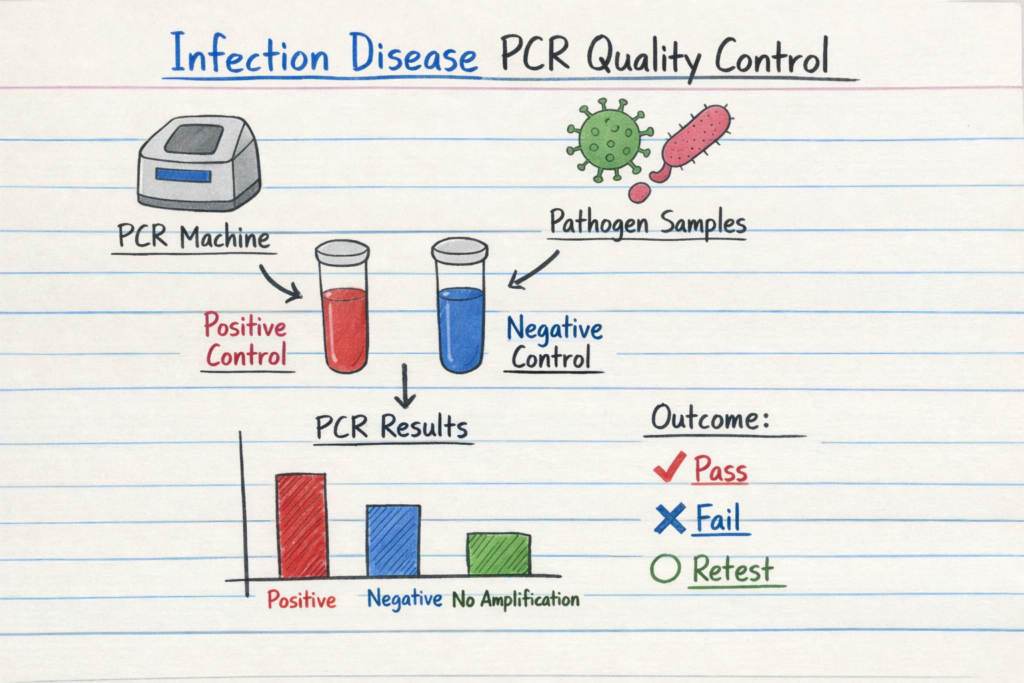
2. Positive and Negative Controls
-
Positive controls: Contain a known quantity of the target pathogen’s genetic material, ensuring that the PCR test is functioning properly and capable of detecting the pathogen.
-
Negative controls: Do not contain any target DNA or RNA, and they help identify contamination that may occur during the testing process.
Both positive and negative controls help identify errors in the PCR process, including contamination or reagent failure.
3. Extraction Controls
Extraction controls verify that DNA or RNA has been successfully extracted from the sample, ensuring that there is enough genetic material to amplify and detect. If extraction fails, PCR will not be able to detect the pathogen, leading to a false negative result.
4. Amplification Controls
Amplification controls monitor the PCR amplification process to ensure that it occurs under optimal conditions. These controls help identify inhibitors or other factors that may interfere with the PCR reaction, ensuring that amplification is successful and accurate.
Best Practices for Implementing Infectious Disease PCR Quality Control
To ensure the highest accuracy and reliability, laboratories must implement best practices in PCR quality control. Here are key recommendations for laboratories performing PCR tests for infectious diseases:
1. Use High-Quality Reagents
High-quality primers, probes, and reagents are essential for ensuring that the PCR reaction proceeds as expected. Low-quality reagents can lead to poor amplification, resulting in unreliable results. Laboratories should source reagents from reputable suppliers and ensure that they meet regulatory standards.
2. Regular Calibration and Maintenance of PCR Equipment
PCR equipment, including thermocyclers and pipettes, must be regularly calibrated and maintained to ensure they function correctly. Regular maintenance reduces the risk of technical issues, such as improper temperature cycling or inaccurate pipetting, which could affect the PCR reaction and the final test results.
3. Participate in External Proficiency Testing
Proficiency testing involves sending blind samples to a laboratory to assess its PCR performance. Participating in proficiency testing helps ensure that laboratories are producing accurate and reliable results. Regular proficiency testing also supports ongoing training and ensures that laboratory staff are up to date with the latest testing procedures.
Benefits of Implementing Infectious Disease PCR Quality Control
The implementation of Infectious Disease PCR Quality Control offers numerous benefits for laboratories, healthcare providers, and patients:
1. Increased Diagnostic Accuracy
Effective quality control measures ensure that PCR tests for infectious diseases yield accurate and reliable results. This improves the ability to identify the pathogen accurately, ensuring that patients receive the appropriate treatment.
2. Cost Savings
Accurate PCR testing reduces the need for repeat tests, minimizing the costs associated with misdiagnoses. Additionally, accurate testing allows for earlier treatment, which can prevent complications and reduce the overall cost of care.
3. Compliance with Regulatory and Accreditation Standards
Adhering to FDA and CDC guidelines ensures that PCR tests meet regulatory standards for accuracy, quality, and reliability. Compliance with these standards helps maintain laboratory accreditation and ensures that test results are trusted by clinicians.
Conclusion: The Importance of Infectious Disease PCR Quality Control for Patient Care
Infectious Disease PCR Quality Control is crucial for ensuring that PCR testing provides accurate, reliable, and reproducible results. By integrating effective quality control measures into the PCR testing process, laboratories can minimize the risk of errors and ensure that patients receive timely and accurate diagnoses. As PCR technology continues to advance, maintaining robust quality control practices will remain essential for ensuring the success of PCR-based diagnostic tests for infectious diseases.
For laboratories, clinicians, and healthcare providers, adopting best practices in Infectious Disease PCR Quality Control will improve the reliability of diagnostics, optimize patient care, and ensure compliance with regulatory standards, contributing to improved health outcomes worldwide.
-
Infectious Disease PCR Quality Control
-
PCR testing for infectious diseases
-
PCR test accuracy
-
HIV PCR diagnostics
-
Hepatitis B PCR test
-
Tuberculosis PCR testing
-
PCR reagents quality control
-
PCR diagnostics regulatory compliance
References:
-
Centers for Disease Control and Prevention (CDC). (2021). HIV Testing Overview. Retrieved from CDC.gov
-
World Health Organization (WHO). (2021). Tuberculosis Diagnostics and PCR. Retrieved from WHO.int
-
FDA Guidelines for PCR Testing in Diagnostic Laboratories. (2020). Retrieved from FDA.gov
-
PCR Testing for Infectious Diseases. (2019). Journal of Clinical Microbiology, 57(6), 42-46.