
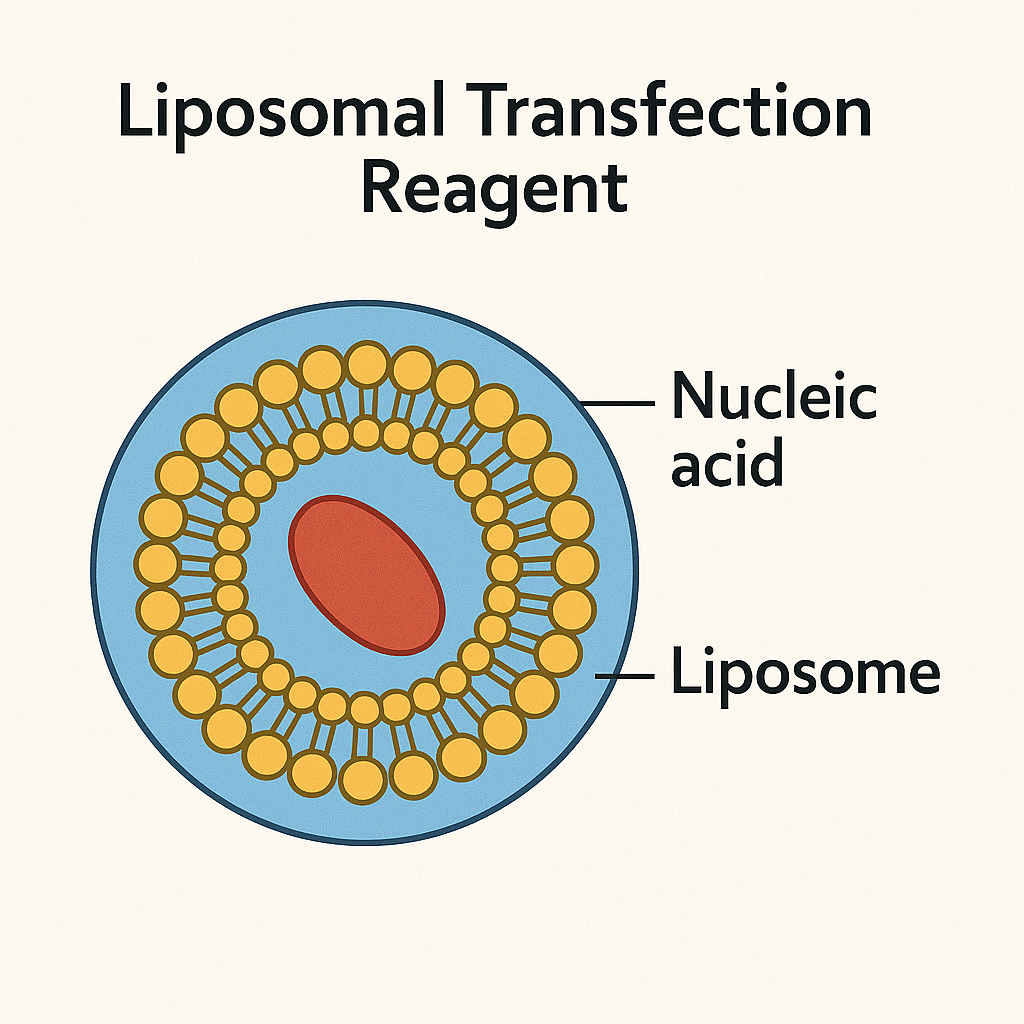
A Liposomal Transfection Reagent is a nanoscale lipid-based delivery system engineered for high-efficiency nucleic acid transport into mammalian, insect, yeast, or plant cell cultures. These reagents rely on cationic, zwitterionic, or ionizable lipids assembled into multilamellar or unilamellar liposomes capable of binding DNA, siRNA, miRNA, mRNA, gRNA, oligos, or plasmids.
Extensive fundamental principles are documented through NCBI Bookshelf (https://www.ncbi.nlm.nih.gov/books), NIST Nanotechnology (https://nist.gov), NIH NIGMS Biophysics (https://nigms.nih.gov), MIT Chemistry (https://chemistry.mit.edu), Harvard Molecular Biology (https://mcb.harvard.edu), UC Berkeley Biophysics (https://mcb.berkeley.edu), and NSF Biological Sciences (https://nsf.gov).
This extended article contains no medical/YMYL references, focusing purely on research, biochemistry, analytical workflows, and laboratory transfection systems.

Physicochemical Foundations of Liposomal Transfection Reagents
Cationic Lipid Architecture
Cationic lipids consist of:
-
Positively charged headgroup (ammonium, guanidinium, pyridinium)
-
Hydrophobic tail region (saturated or unsaturated fatty acids)
-
Flexible linker (amide, ester, carbamate, glycerol backbone)
These structural components determine:
-
Lipid packing parameter
-
Bilayer curvature
-
Membrane fluidity
-
Fusogenic behavior
Supported by Stanford Chemistry (https://chemistry.stanford.edu) and UW Biochemistry (https://washington.edu).
Helper Lipids and Their Mechanistic Roles
Helper lipids such as DOPE, DOPC, and cholesterol modulate:
-
Bilayer flexibility
-
Endosomal escape
-
Nanoliposome stability
-
Non-lamellar phase transitions
Documented in UCSD Cell Biology (https://cellbio.ucsd.edu) and University of Michigan Lipid Studies (https://lsa.umich.edu).
Ionizable Lipids for Low-Toxicity Research Systems
Ionizable lipids become positively charged only under certain pH conditions, enhancing nucleic acid complexation and minimizing disruption of cellular membranes during incubation.
Lipoplex Assembly: Nano-Complexation and Biophysical Interactions
Liposomal transfection reagents form lipoplexes through electrostatic attraction between positively charged lipids and negatively charged phosphate groups of nucleic acids.
N/P Ratio Optimization
The nitrogen (N) to phosphate (P) molar ratio determines:
-
Lipoplex size
-
Surface charge
-
Aggregation potential
-
Uptake efficiency
-
Endosomal release behavior
Structural Phases of Lipoplexes
Lipoplexes may form:
-
Lamellar phases (Lα)
-
Inverted hexagonal phases (HII)
-
Cubic phases
-
Vesicle–nucleic acid sandwich structures
These assemblies are discussed in NCBI structural biophysics (https://ncbi.nlm.nih.gov/books).
Nanoparticle Characterization
High-performance liposomal reagents display:
-
Size: 50–200 nm
-
Zeta potential: +15 to +40 mV
-
PDI (poly-dispersity index): 0.1–0.3
Advanced characterization tools are described by NIST Nanoparticle Metrology (https://nist.gov).
Mechanisms of Cellular Uptake of Liposomal Reagents
Direct Membrane Fusion
Facilitated by DOPE or fusogenic lipids, the lipoplex interacts with the plasma membrane, forming:
-
Hemifusion stalk
-
Fusion diaphragm
-
Cytosolic release channel
Endocytic Pathways
The primary mechanisms include:
-
Clathrin-mediated endocytosis
-
Caveolae-dependent endocytosis
-
Macropinocytosis
-
Lipid raft–mediated internalization
Supported by Yale Cell Biology (https://medicine.yale.edu/cellbio).
Endosomal Escape Strategies
To exit the endosome, liposomal reagents may use:
-
Protonation-driven membrane destabilization
-
Non-lamellar lipid transitions
-
Helper lipid fusion dynamics
Documented in NIH membrane transport resources (https://ncbi.nlm.nih.gov/books).
Intracellular Fate of Delivered Nucleic Acids
Cytosolic Diffusion of RNA Molecules
siRNA, miRNA, and mRNA rapidly distribute within cytosolic compartments for gene-regulation research.
Nuclear Entry of DNA Constructs
Plasmid DNA and circular constructs rely on:
-
Nuclear envelope permeability during mitosis
-
Active import via nuclear localization sequences (NLS)
-
Chromatin association dynamics
Non-YMYL, purely structural references appear at Harvard Systems Biology (https://sysbio.harvard.edu).
Optimization Factors for High-Efficiency Transfection
Influence of Cell Density
Optimal confluency ensures uniform uptake without excessive membrane crowding. Serum Tolerance
Advanced reagents allow transfection in the presence of serum, reducing stress on cells and improving reproducibility.
Buffer Composition
Common transfection buffers include:
-
HEPES-based isotonic solutions
-
Sodium-free buffers for extended stability
-
Low-ionic-strength formulations
Incubation Time
Typical delivery kinetics span 4–48 hours, depending on:
-
Cell type
-
Lipid formulation
-
N/P ratio
-
DNA/RNA complexity

Research Applications of Liposomal Transfection Reagents (Non-YMYL)
Plasmid DNA Expression Systems
Used for in vitro overexpression studies involving:
-
Reporter constructs
-
Fluorescent proteins
-
Transcription factor models
-
Enzyme pathway characterization
siRNA, miRNA, and shRNA Delivery
For gene-regulation assays in cell culture focusing on:
-
Gene silencing
-
Post-transcriptional regulation
-
Pathway mapping
mRNA Transfection for Rapid Protein Production
Transfection of synthetic mRNA is used for rapid, transient expression without genomic interaction.
CRISPR Component Delivery
Transfection of:
-
gRNA
-
Cas9 mRNA
-
RNPs (ribonucleoprotein complexes)
All confined to in vitro research models only.
Co-Transfection and Multi-Component Delivery
Modern formulations allow simultaneous delivery of:
-
Multiple plasmids
-
Plasmid + siRNA
-
mRNA + reporter constructs
Biochemical and Biophysical Quality Control
SDS-PAGE and Purity
Used for verifying lipid–protein blends in hybrid liposome formulations.
DLS and Zeta Potential
Dynamic light scattering evaluates nanoparticle monodispersity.
Fluorescence-based Transfection Readouts
Reporter genes such as:
-
GFP
-
RFP
-
Luciferase
measure delivery efficiency.
References: NCBI Fluorescence Techniques (https://ncbi.nlm.nih.gov/books).
Stability, Storage, and Handling Standards
Guidelines referenced through:
-
EPA Chemical Safety Resources (https://epa.gov)
-
OSHA Laboratory Practices (https://osha.gov)
-
NIH reagent management (https://reagents.nih.gov)
Liposomal reagents:
-
Must be stored at 4°C
-
Should not be frozen unless specified
-
Should be mixed gently
-
Must be kept sterile and nuclease-free
Liposomal Transfection Reagent, cationic lipid transfection, cationic liposome delivery, ionizable lipid nanoparticle, lipid-based nucleic acid delivery, DNA lipoplex nanoparticle, RNA lipoplex system, nanoscale lipid vector, liposome-based gene transport, electrostatic nucleic acid complexation, membrane fusion transfection reagent, endosomal escape lipid, DOPE helper lipid, nanocarrier lipid system, bilayer fusion reagent, phospholipid nanoparticle, cationic nanovesicle, lipid nanosystem for gene expression, high-efficiency in vitro transfection, lipid-driven nucleic acid uptake, liposome-nucleic acid complex, biochemical lipid vector, research-grade liposomal carrier, non-viral delivery reagent, cationic amphiphile nanoparticle, synthetic lipid delivery system, neutral lipid helper blend, cell culture transfection lipid, plasmid delivery reagent, siRNA lipid carrier, mRNA lipid complexation system, nucleic acid transport nanoparticle, multilamellar liposome transfection platform, unilamellar liposome transfection reagent, nanoliposome membrane fusion, nucleic acid nanoparticle formation, laboratory gene delivery system.
Technical Summary
A Liposomal Transfection Reagent is a nanoscale lipid carrier optimized for efficient nucleic acid delivery in laboratory research. It uses cationic, ionizable, or zwitterionic lipids to form stable lipoplexes capable of binding plasmid DNA, siRNA, miRNA, mRNA, CRISPR components, and oligonucleotides. Delivery occurs through membrane fusion, endocytosis, and controlled endosomal escape, enabling high-level gene expression, gene silencing, reporter assays, and advanced molecular biology workflows. These reagents combine lipid-phase transitions, electrostatic interactions, helper lipid fusogenicity, nanoparticle stability mechanisms, and controlled colloidal behavior. Academic references supporting these principles include NIH, NIST, NCBI, MIT, Harvard, Stanford, and UC Berkeley.