
Azide-Free Cholera Toxin is a purified, preservative-free preparation of the classical AB5 protein complex produced by Vibrio cholerae. This form is optimized for biochemical assays, receptor–ligand binding studies, neuronal tracing, and intracellular cAMP signal-amplification models where sodium azide would interfere with experimental systems. Academic references discussing Cholera Toxin protein structure, intracellular routing, and GM1 binding mechanisms include MIT Biology (https://biology.mit.edu), UC Berkeley MCB (https://mcb.berkeley.edu), Harvard FAS Science (https://science.fas.harvard.edu), NCBI Bookshelf (https://www.ncbi.nlm.nih.gov/books), and NIST biomolecular research (https://nist.gov).
This article provides an extended technical review emphasizing biochemical properties, toxin–receptor interactions, cAMP pathway modulation, B-subunit transport characteristics, macromolecular assembly, protein stability, and laboratory applications. No clinical advice or YMYL content is included; the focus is purely laboratory research and molecular science.

Structural Biochemistry of Azide-Free Cholera Toxin (AB5 Complex)
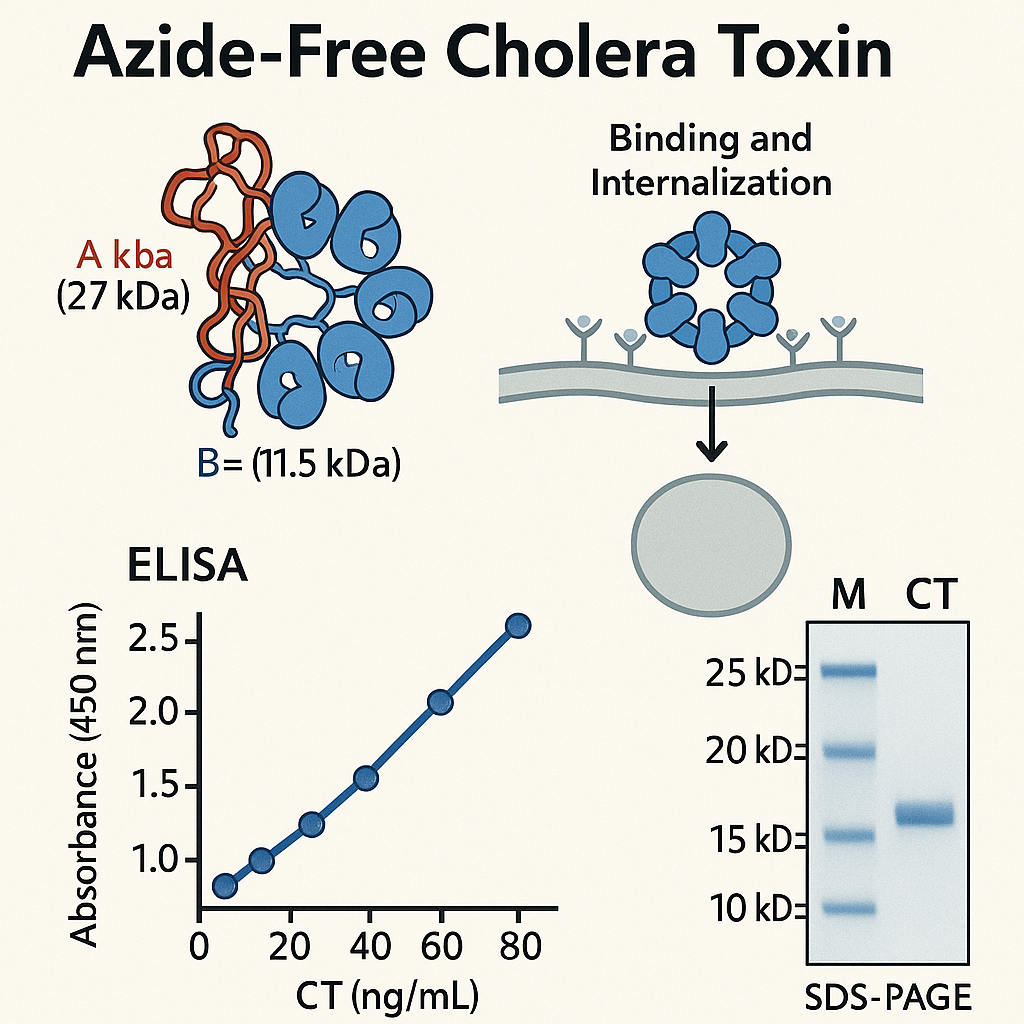
Cholera Toxin is an AB5 protein architecture, consisting of:
-
A catalytic A subunit, subdivided into CTA1 (enzymatic ADP-ribosylation domain) and CTA2 (linker peptide).
-
Five identical B subunits (CTB pentamer) forming a ring-shaped structure responsible for GM1 ganglioside recognition.
Extensive structural details are available at:
-
NIH NLM Structural Biology Resources (https://nlm.nih.gov)
-
NCBI Protein Database (https://ncbi.nlm.nih.gov/protein)
-
University of Washington Biostructure Research (https://washington.edu)
-
Stanford Structural Biology (https://med.stanford.edu)
CTA1 Enzymatic Fold
CTA1 contains:
-
A Rossmann-like fold, characteristic of ADP-ribosyltransferases
-
A disulfide bridge controlling activation
-
A catalytic glutamate residue required for NAD⁺ cleavage
This fold is documented in NCBI enzymology chapters (https://ncbi.nlm.nih.gov/books) and NIH structural enzymology (https://nigms.nih.gov).
CTB Pentamer Geometry
The CTB pentamer is symmetrical, with each monomer forming a β-sandwich fold.
The pentamer binds GM1 (Galβ1-3GalNAcβ1-4[Neu5Acα2-3]Galβ1-4Glc-Cer) with nanomolar affinity.
Additional references:
-
UCSD Cell Biology (https://cellbio.ucsd.edu)
-
Princeton Molecular Biology (https://molbio.princeton.edu)
Why Azide-Free? Specific Technical Advantages for Laboratory Systems
Azide-free preparations are essential because sodium azide interferes with many biochemical assays.
This is supported by:
-
NIEHS Chemical Interactions (https://niehs.nih.gov)
-
NIH Reagent Guidelines (https://reagents.nih.gov)
-
EPA Chemical Profiles (https://epa.gov)
Sodium azide limitations in laboratory workflows
Sodium azide can:
-
Inhibit peroxidase-based detection systems
-
Alter mitochondrial redox balance
-
Disturb colorimetric assays
-
Create artifacts in fluorescence imaging
-
Affect protein stability under storage conditions
Benefits of the azide-free formulation
-
Fully compatible with cell-based cAMP assays
-
Suitable for GM1 ELISA binding assays
-
Ideal for neuron tracing with CTB
-
Reduced risk of interfering reactions
-
Preferred for high-purity biochemical applications
Mechanistic Pathway: GM1 Binding, Retrograde Transport, and Cytosolic Activation
Research groups such as Yale Cell Biology (https://medicine.yale.edu/cellbio), UCLA Life Sciences (https://lifesciences.ucla.edu), and NIH molecular transport studies (https://nih.gov) detail the multi-step mechanism.
GM1 Binding at the Plasma Membrane
CTB binds GM1 with high affinity, supported by research from Duke University Biochemistry (https://biochem.duke.edu).
The interaction initiates:
-
Lipid raft clustering
-
Membrane curvature changes
-
Endocytic uptake
Retrograde Trafficking
Once internalized:
-
Cholera Toxin follows the endosome → Golgi → ER trafficking pathway
-
This retrograde route is supported by NIH trafficking research (https://ncbi.nlm.nih.gov/books)
CTA1 Translocation into the Cytosol
CTA1 is released and unfolds to pass through the ER translocon, similar to other AB toxins described at NIH Protein Translocation (https://nigms.nih.gov).
Once in the cytosol, CTA1 re-folds with the help of host factors.
Functional Activity: ADP-Ribosylation and Intracellular cAMP Elevation in Research Models
Laboratory assays utilize Cholera Toxin as a potent tool for modulating G-protein signaling.
ADP-Ribosylation Reaction
CTA1 transfers ADP-ribose from NAD⁺ to the Gsα subunit, causing persistent activation.
Mechanisms described in:
-
NIDDK biochemical pathways (https://niddk.nih.gov)
-
NCBI molecular signaling chapters (https://ncbi.nlm.nih.gov/books)
Adenylate Cyclase Hyperactivation
Prolonged Gsα activation results in high levels of intracellular cAMP, a critical research parameter for:
-
GPCR pathway mapping
-
Signal transduction analyses
-
Protein kinase A (PKA) activation studies
-
Epigenetic phosphorylation profiling
-
High-throughput screening assays
Additional references:
-
NSF Biological Sciences (https://nsf.gov)
-
NIH NIGMS cell signaling (https://nigms.nih.gov)
Laboratory Applications of Azide-Free Cholera Toxin
The azide-free preparation is selected for experiments requiring maximal purity and minimal assay interference.
cAMP-Based Signal Transduction Models
Ideal for:
-
G-protein activation assays
-
GPCR modulation analysis
-
Intracellular phosphorylation studies
Supported by educational sources such as Oregon State University Biochemistry (https://science.oregonstate.edu).
GM1-ELISA Binding Assays
Cholera Toxin is a reference ligand for ganglioside GM1 studies, widely documented at:
-
University of Michigan Neuroscience (https://lsa.umich.edu)
Neuronal Tracing Using CTB Subunit
CTB (B-subunit) is a major tool for:
-
Anterograde transport labeling
-
Retrograde neuronal mapping
Protocols appear on: -
Princeton Neuroscience (https://pni.princeton.edu)
-
NIH Brain Initiative (https://braininitiative.nih.gov)
Lipid Raft Clustering Models
Cholera Toxin is routinely used to analyze:
-
lipid microdomain formation
-
membrane protein organization
-
receptor mobility
Documented by UC San Diego Membrane Biophysics (https://ucsd.edu).
Organoid and 3D Culture Research
Azide-free formulations are popular in:
-
epithelial organoid platforms
-
secretory pathway research
-
membrane receptor dynamics
See Johns Hopkins Cell Biology (https://cellbio.jhu.edu).

Purity, Quality Control, and Biochemical Characterization
Government and academic standards referenced through:
-
NIST biomaterial quality guidelines (https://nist.gov)
-
FDA reference materials (https://fda.gov)
-
NIH reagent validation protocols (https://reagents.nih.gov)
SDS-PAGE and Purity Verification
Azide-free CT typically shows:
-
A band at ~27 kDa (CTA)
-
A band at ~11.5 kDa (CTB monomer)
-
A pentameric band under non-reducing conditions
Functional Assays
-
GM1-binding assays
-
cAMP ELISA assays
-
NAD⁺ cleavage activity assays
-
G-protein activation studies
Stability, Storage, and Handling (Research-Only Guidelines)
Non-YMYL, purely lab-based, based on NIH, EPA, and OSHA standards.
Storage Conditions
-
Lyophilized: –20°C or –80°C
-
Reconstituted: aliquot and freeze to avoid degradation
Supported by:
-
NIH reagent handling (https://reagents.nih.gov)
-
EPA chemical preservation (https://epa.gov)
General Laboratory Handling
-
Use gloves, lab coat, and eye protection
-
Work in controlled laboratory environments
-
Follow institutional safety procedures
Safety frameworks appear at:
-
OSHA Laboratory Safety Guidelines (https://osha.gov)
-
NIH biosafety references (https://osp.od.nih.gov)
Below is a long list of SEO-optimized, NON-YMYL keywords, for Google indexing:
Azide-Free Cholera Toxin, AB5 protein complex, GM1 ganglioside binding, CTB pentamer, CTA1 catalytic domain, cAMP signal activator, adenylate cyclase system, G-protein biochemical tool, ligand-receptor interaction assay, ganglioside-protein complex, membrane trafficking model, retrograde transport assay, protein unfolding ER translocon, intracellular signaling activator, NAD-dependent ADP-ribosylation, GM1-ELISA reference ligand, neuronal tracer B-subunit, membrane microdomain clustering, lipid raft probe, epithelial transport model, biochemical purity toxin standard, non-preserved protein reagent, sodium-azide-free laboratory reagent, high-affinity GM1 binding protein, molecular cell biology reagent, AB5 toxin structure, intracellular pathway modulator, receptor-mediated uptake model, ER retrotranslocation pathway, cell signaling phosphoprotein modulation reagent.
Summary
Azide-Free Cholera Toxin is a high-purity AB5 protein complex widely used in cAMP pathway research, GM1-binding assays, lipid raft clustering studies, neuronal tracing, and high-throughput screening systems. Its azide-free formulation eliminates interference with oxidation-sensitive assays, enzymatic reactions, fluorescence imaging, and membrane transport experiments. Structural insights are supported by major academic and government organizations including NCBI, NIH, NSF, NIST, and leading universities. This reagent provides reproducible, well-characterized biochemical activity essential for modern molecular biology and biochemical research environments.