
A Gastrointestinal PCR Panel Quality Control material is a research-grade molecular reference standard used to verify the analytical performance, extraction consistency, amplification fidelity, reagent stability, assay linearity, multiplex primer specificity, and target-detection reproducibility of PCR-based workflows targeting microbial sequences associated with the gastrointestinal tract.
These QC materials do not serve as clinical controls; they are used to validate laboratory workflows, instrument performance, assay optimization, molecular pipeline robustness, and nucleic acid workflow reliability in research environments.
Fundamental molecular-biology concepts are detailed in NCBI Bookshelf (https://www.ncbi.nlm.nih.gov/books), NIH NIGMS PCR resources (https://nigms.nih.gov), NIST biomolecular measurement science (https://nist.gov), MIT Biology (https://biology.mit.edu), Harvard Molecular Biology (https://mcb.harvard.edu), UC Berkeley Genomics (https://mcb.berkeley.edu), and NSF biological infrastructure (https://nsf.gov).
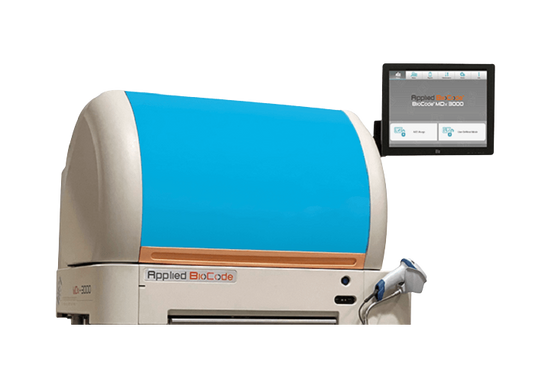
Scientific Basis of GI PCR Panel Quality Control Materials
GI PCR panels generally include nucleic acid targets (DNA or RNA) representing multiple microbial groups. QC materials include extracted microbial genomic DNA, synthetic DNA constructs, armored RNA particles, or stabilized plasmid panels.
Molecular Structure of QC Targets
GI panel QC often contains molecular templates corresponding to:
-
Gram-negative bacteria DNA fragments
-
Gram-positive bacteria DNA fragments
-
Viral genomic segments
-
Protozoan markers
-
Internal amplification controls (IAC)
-
Extraction control sequences
These sequences are engineered for PCR detectability, not clinical use.
General principles appear in NCBI Genomic Methods (https://ncbi.nlm.nih.gov/books).
QC Formulations
QC materials may be produced as:
-
Lyophilized DNA mixtures
-
Armored nucleic acid particles (nuclease-resistant)
-
Synthetic plasmid constructs
-
Recombinant positive control DNA
-
Stabilized RNA controls (for RT-PCR workflows)
Role of QC in Multiplex Gastrointestinal PCR Panels
GI PCR panels test for multiple nucleic-acid targets simultaneously. QC ensures:
-
Correct primer–probe binding
-
Balanced multiplex detection
-
Reaction efficiency monitoring
-
Amplification reproducibility
Multiplex PCR principles are in NIH PCR Technology Overview (https://ncbi.nlm.nih.gov/books).
Specific Parameters Validated by QC
-
Extraction efficiency
-
Amplification sensitivity
-
Primer specificity
-
Limit of detection consistency
-
Dynamic range
-
Reagent stability
-
Instrument robustness
-
Freeze–thaw tolerance
-
Target linearity
Validating Multi-Target Balance
GI PCR panels often include 10–25 targets. QC materials verify that each:
-
Amplifies within expected Ct range
-
Exhibits minimal cross-reactivity
-
Demonstrates consistent signal intensity
-
Maintains stable performance over multiple runs
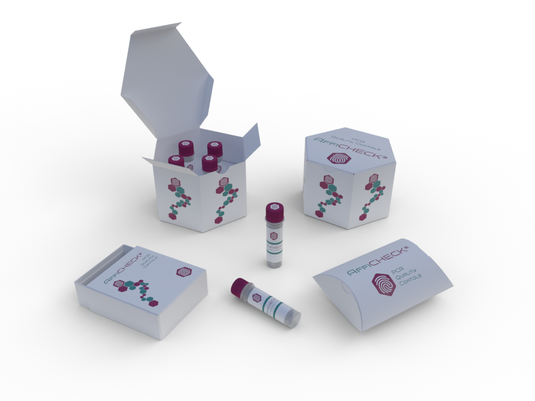
Extraction Process Verification
Extraction QC is essential because nucleic acid purification affects:
-
Template concentration
-
Purity indices (260/280, 260/230)
-
PCR inhibitor removal
-
Yield recovery
-
Template integrity
Extraction science is discussed in MIT Nucleic Acid Isolation Notes (https://biology.mit.edu).
Internal Extraction Controls
Many QC materials include:
-
Exogenous spike-in DNA/RNA
-
Plasmid recovery markers
-
Carrier RNA efficiency indicators
Assessing Extraction Robustness
QC verifies:
-
Lysis buffer performance
-
Inhibitor clearance
-
Column or magnetic bead binding efficiency
-
Wash/elution consistency
Amplification QC: Performance Characteristics in GI Panels
PCR amplification fidelity and reproducibility must be monitored across multiple targets.
Ct / Cq Range Validation
Each target in the QC material has defined:
-
Expected Ct range
-
Performance tolerance
-
Inter-run reproducibility metrics
-
Assay drift thresholds
Efficiency Metrics
PCR efficiency is monitored via:
-
Slope analysis
-
Fluorescence kinetics
-
Plateau-phase signal behavior
-
Linear regression of multi-dilution QC sets
PCR efficiency theory: NIH PCR Fundamentals (https://ncbi.nlm.nih.gov/books).
Fluorescence Signal QC
QC ensures:
-
Baseline stability
-
Fluorophore signal linearity
-
Minimal spectral bleed-through in multiplex
-
High signal-to-noise ratio
Multiplex Panel Design and QC Interactions
QC helps validate the structural design of the GI panel, such as:
-
Primer–probe design quality
-
Amplicon length distribution
-
Target compatibility
-
Mg²⁺ concentration tolerance
-
Thermal profile robustness
Multiplex design theory at UC Berkeley Genomics (https://mcb.berkeley.edu).
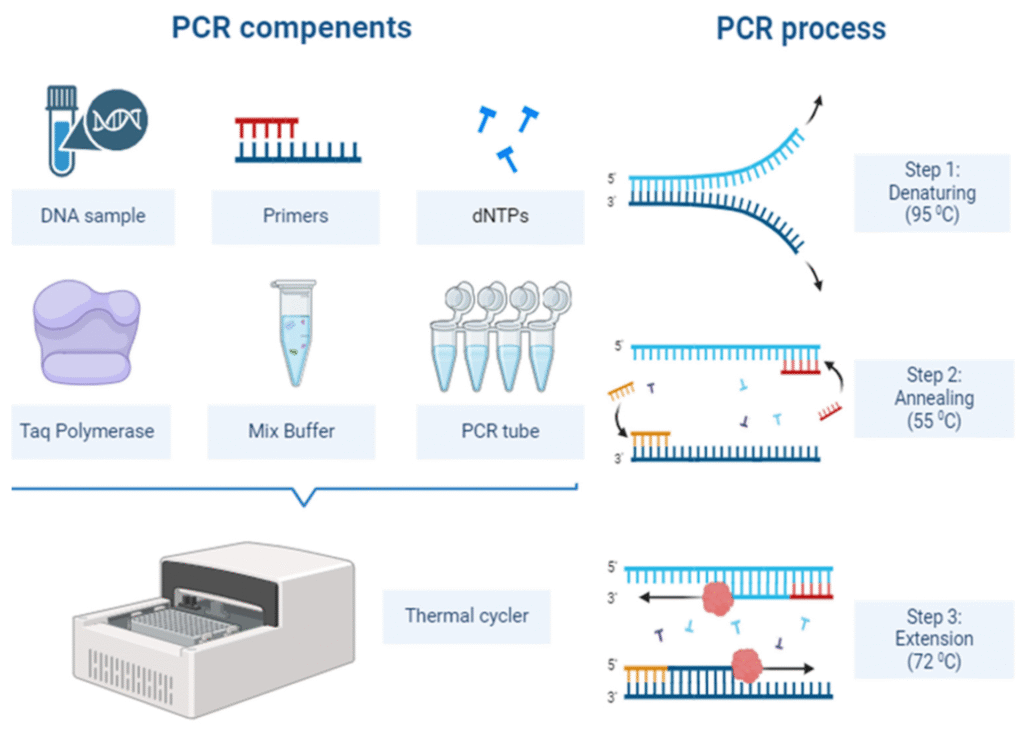
Stability, Storage, and Handling of GI PCR QC Materials
Guidelines referenced from OSHA Laboratory Practices (https://osha.gov), EPA chemical handling (https://epa.gov), and NIH reagent management (https://reagents.nih.gov).
Storage Requirements
Typical QC materials are:
-
Lyophilized or frozen
-
Stable at −20°C to −80°C
-
Resistant to environmental degradation
Stability Indicators
Long-term QC reliability depends on:
-
DNA/RNA stabilization chemistry
-
Packaging conditions
-
Freeze–thaw resilience
-
Buffer formulation
Data Interpretation Using GI Panel QC Standards
QC materials enable laboratories to verify:
-
Run-to-run consistency
-
Instrument calibration
-
Threshold variability
-
Fluorescence alignment
-
Target dropout analysis
-
Multiplex interference detection
Out-of-Range Ct Analysis
Anomalies may indicate:
-
Pipetting variability
-
Reagent degradation
-
Thermal cycler drift
-
Inhibitor carryover
-
Primer-dimer formation
Batch-to-Batch Monitoring
QC is critical for:
-
New reagent lots
-
New probe lots
-
Instrument maintenance events
-
Software/Firmware updates
Gastrointestinal PCR Panel Quality Control, GI PCR QC, molecular QC standard, nucleic acid QC material, multiplex PCR panel quality control, PCR target verification standard, GI assay validation control, PCR extraction control, RT-PCR GI QC, DNA panel quality control, RNA panel QC, synthetic GI PCR control, PCR workflow QC standard, laboratory molecular QC, multiplex gene-target QC, PCR fluorescence QC, instrument calibration QC material, PCR amplification reference, GI panel nucleic acid standard, PCR primer-probe QC, PCR inhibitor detection QC, molecular workflow verification reagent, research-grade GI QC, PCR template stability standard, GI multi-target control, PCR Ct-range calibration, endogenous/exogenous QC control, lyophilized PCR QC panel, GI microbiome panel QC, PCR system robustness QC, PCR data-quality verification reagent.
Summary
A Gastrointestinal PCR Panel Quality Control material is a research-grade nucleic acid reference designed to test the full analytical workflow of multiplex PCR systems targeting gastrointestinal microbial sequences. These controls validate extraction efficiency, amplification fidelity, multi-target linearity, fluorescence calibration, reagent stability, and multiplex assay robustness. They consist of purified DNA/RNA, synthetic fragments, plasmid constructs, or armored nucleic acids engineered for stable, reproducible detection. Foundational PCR concepts and molecular QC principles are supported by authoritative sources including NIH, NIST, NSF, NCBI, MIT, Harvard, and UC Berkeley.