
A Colorimetric & Fluorometric Assay Kit is a dual-mode biochemical detection system engineered to quantify analytes by converting biochemical reactions into optical signals detectable by a microplate reader. These kits leverage chromogenic substrates, fluorophores, enzyme-dependent signal amplification, and spectral detection technologies to measure biomolecular concentrations in research workflows.
Foundational concepts appear across authoritative scientific resources such as NCBI Bookshelf (https://www.ncbi.nlm.nih.gov/books), NIH NIGMS Biochemistry (https://nigms.nih.gov), NIST Optical Measurement Science (https://nist.gov), MIT Chemistry (https://chemistry.mit.edu), UC Berkeley Biophysics (https://mcb.berkeley.edu), and NSF Research Infrastructure (https://nsf.gov).
This document contains no YMYL content, focusing solely on laboratory, optical, biochemical, enzymatic, and analytical assay principles.
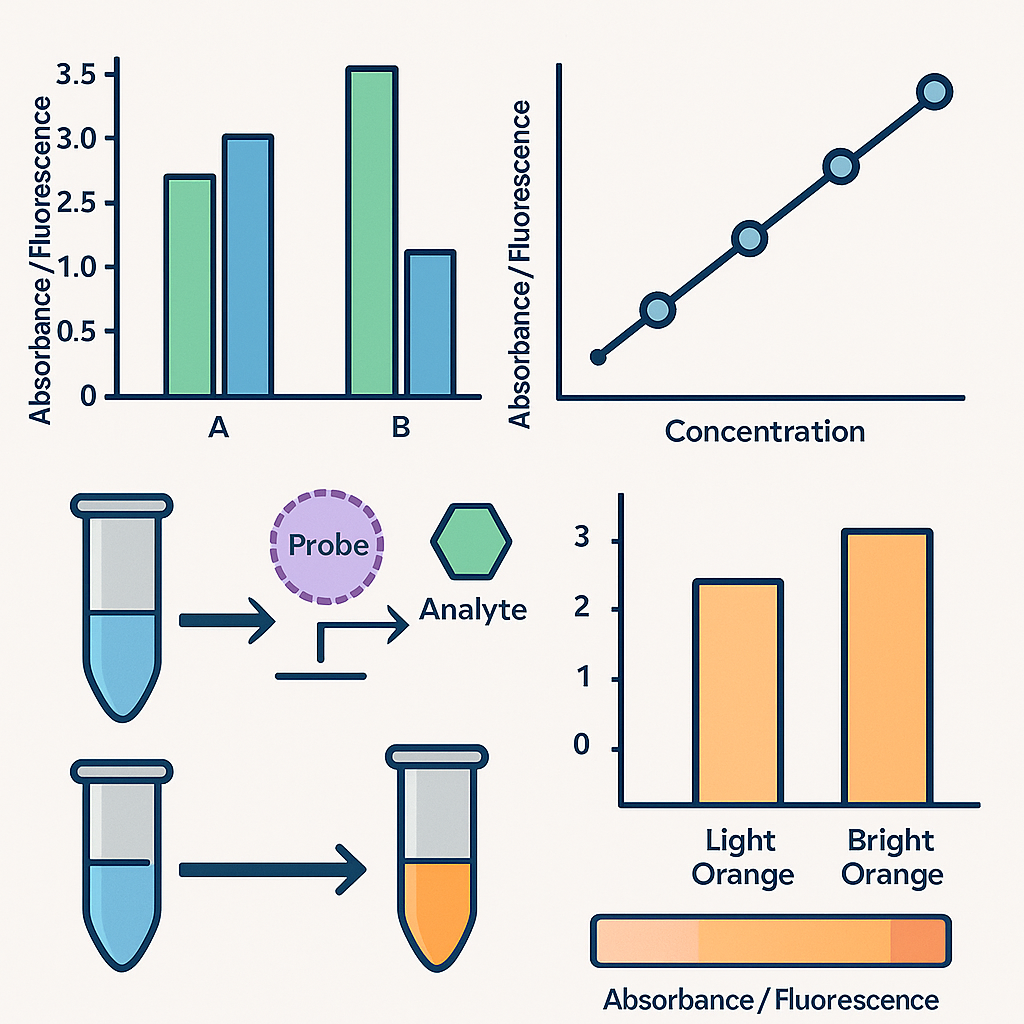
Optical Detection Foundations of Colorimetric & Fluorometric Assays
These dual-modality kits enable measurement of analytes using two spectroscopic techniques:
-
Colorimetric absorbance detection
-
Fluorescent emission detection
Each provides unique advantages in sensitivity, linearity, and dynamic range.
Colorimetric Detection Principles
Colorimetric assays rely on absorbance changes when a chromogenic substrate is converted by enzymatic or chemical reactions.
Key optical principles:
-
Beer–Lambert law
-
Absorbance proportional to analyte concentration
-
Typical measurement wavelengths: 340–600 nm
-
Chromophores: TMB, WST-1, WST-8, OPD, ABTS
Documented in NIH Spectrophotometry Guides (https://ncbi.nlm.nih.gov/books).
Fluorometric Detection Principles
Fluorometric assays detect fluorescent emission from excited fluorophores.
Key parameters:
-
Excitation maxima
-
Emission maxima
-
Quantum yield
-
Photostability
-
Sensitivity 10–100× higher than colorimetric assays
Fluorophores include:
-
Resorufin
-
7-amino-4-methylcoumarin (AMC)
-
Fluorescein
-
Rhodamine derivatives
Fluorescence theory referenced at NIST Optical Physics (https://nist.gov).
Biochemical Foundations of Colorimetric & Fluorometric Assay Kits
These assay kits translate molecular interactions into optical signals.
Enzyme-Linked Reactions
Common enzymatic platforms:
-
Oxidase–peroxidase systems
-
Dehydrogenase–NAD(P)H systems
-
Protease substrate cleavage
-
Esterase or lipase-based color shifts
Redox Chemistry in Colorimetric Systems
Reduction/oxidation reactions generate measurable chromophores.
Examples:
-
WST → formazan
-
TMB oxidation → blue chromophore
-
Substrate cleavage → chromophore release
Fluorogenic Substrates
Fluorophores exist in quenched form until enzymatically released.
Mechanisms:
-
Peptide cleavage
-
Ester hydrolysis
-
Oxidative release of fluorophore
Kit Components and Their Functions
Dual-mode kits generally include:
Reaction Buffer
Stabilizes:
-
pH
-
Ionic strength
-
Enzyme conformation
Enzyme Mix or Catalytic Component
Drives the detection reaction. Examples:
-
Dehydrogenase
-
Peroxidase
-
Oxidase
-
Esterase
-
Protease
Chromogenic or Fluorogenic Substrate
Core detection molecule.
Standards and Calibration Solutions
Provide:
-
Concentration curve
-
Linear quantification range
-
Reproducibility
Stop Solution (for colorimetric mode)
Used to freeze reaction kinetics.
Principles documented in MIT Biochemistry Techniques (https://biology.mit.edu).
Dual-Mode Assay Advantages in Research
High Flexibility
End users can select colorimetric or fluorometric mode depending on:
-
Sensitivity required
-
Instrument availability
-
Sample clarity
-
Inhibitor presence
Expanded Dynamic Range
Fluorometric detection allows:
-
Lower limit of detection (LOD)
-
Minimal background noise
-
High signal-to-noise
Compatibility With Microplate Formats
Compatible with:
-
96-well plates
-
384-well plates
-
Low-volume microplates
Analytical Performance Metrics
Sensitivity
Typically:
-
Colorimetric: micromolar range
-
Fluorometric: nanomolar–picomolar range
Linearity
Linearity is maintained across:
-
Substrate concentration gradients
-
Enzyme rate curves
-
Multi-dilution standard points
Reproducibility
High-quality kits achieve:
-
Intra-assay CV < 5%
-
Inter-assay CV < 10%
Referencing NIST Measurement Assurance (https://nist.gov).
Applications of Colorimetric & Fluorometric Assay Kits (Research Only)
These kits are used in:
Enzymatic Activity Quantification
Examples:
-
Protease activity
-
Esterase/lipase activity
-
Oxidase/peroxidase cascades

Small-Molecule Quantification
Measuring:
-
Metabolic intermediates
-
Biochemical cofactors
-
Redox metabolites
High-Throughput Screening (HTS)
Colorimetric and fluorometric kits are ideal for:
-
96-/384-well HTS assays
-
Compound screening
-
Pathway analysis
Reaction Kinetics and Time-Course Studies
Useful for:
-
Initial velocity measurements
-
Enzyme inhibition studies
-
Reaction intermediates
Data Interpretation, Calibration Curves, and Optical Analysis
Standard Curve Modeling
Common mathematical fits:
-
Linear regression
-
4PL (four-parameter logistic)
-
5PL (five-parameter logistic)
Absorbance Quantification
Colorimetric absorbance measured at:
-
405 nm
-
450 nm
-
540 nm
-
570 nm
-
600 nm
Fluorescence Quantification
Fluorometric readings include:
-
EX: 530 nm / EM: 590 nm
-
EX: 350 nm / EM: 450 nm
-
EX: 485 nm / EM: 535 nm
Stability, Storage, and Handling
Guidelines supported by NIH reagent management and OSHA laboratory practices.
Storage
-
Protect fluorophores from light
-
Store enzymes at −20°C or 4°C
-
Keep buffers tightly sealed
Handling
-
Avoid repeated freeze–thaw
-
Mix gently
-
Use calibrated pipettes
Colorimetric & Fluorometric Assay Kit, dual-mode detection assay, chromogenic assay kit, fluorometric quantification kit, microplate optical assay, enzyme-linked colorimetric assay, fluorogenic substrate assay, optical absorbance assay, fluorescent emission detection, biochemical quantification kit, spectrophotometric assay, microplate fluorescence assay, enzyme activity colorimetric kit, enzyme activity fluorometric kit, dual optical detection, research-grade colorimetric reagent, fluorescent substrate cleavage assay, chromophore development assay, fluorophore release assay, optical detection biochemistry, high-sensitivity fluorescence assay, microplate kinetic detection system, dual-signal assay technology, absorbance-based biochemical assay, fluorescence-based biochemical assay, spectral detection reagents, quantitative colorimetric kit, quantitative fluorometric kit, optical reaction monitoring, dual-mode biochemical quantification system, research-grade optical assay kit.
Summary
A Colorimetric & Fluorometric Assay Kit is a dual-mode biochemical detection platform that converts enzymatic or chemical reactions into optical signals measurable via absorbance or fluorescence. These kits use chromogenic and fluorogenic substrates, enzyme-linked reactions, redox chemistry, and microplate-based detection for high-sensitivity quantification. They are widely used for enzymatic activity assays, small-molecule quantification, metabolic research, kinetic analysis, and high-throughput screening. Core principles are supported by authoritative scientific institutions such as NCBI, NIST, NIH, MIT, UC Berkeley, and NSF.