
Conventional Polymerase Chain Reaction (PCR) remains one of the most fundamental and indispensable molecular biology techniques in use today. While advanced technologies such as real-time PCR, digital PCR, and next-generation sequencing continue to expand analytical capabilities, conventional PCR persists as a core laboratory method for DNA amplification, screening, verification, and method development.
This extended guide explores conventional PCR in depth, covering its molecular principles, reaction design, optimization strategies, laboratory workflows, and diverse applications, with a strong focus on practical laboratory use rather than clinical interpretation.
Historical context and scientific foundation of PCR
PCR was first described in the 1980s and rapidly transformed molecular biology by enabling in vitro amplification of specific DNA sequences. Its development eliminated the need for cloning DNA fragments into living cells for amplification, significantly accelerating genetic analysis.
Educational overviews from U.S. government and academic institutions explain the historical and scientific importance of PCR:
Conventional PCR laid the foundation for nearly all modern nucleic acid–based techniques used today.

Molecular mechanism of conventional PCR
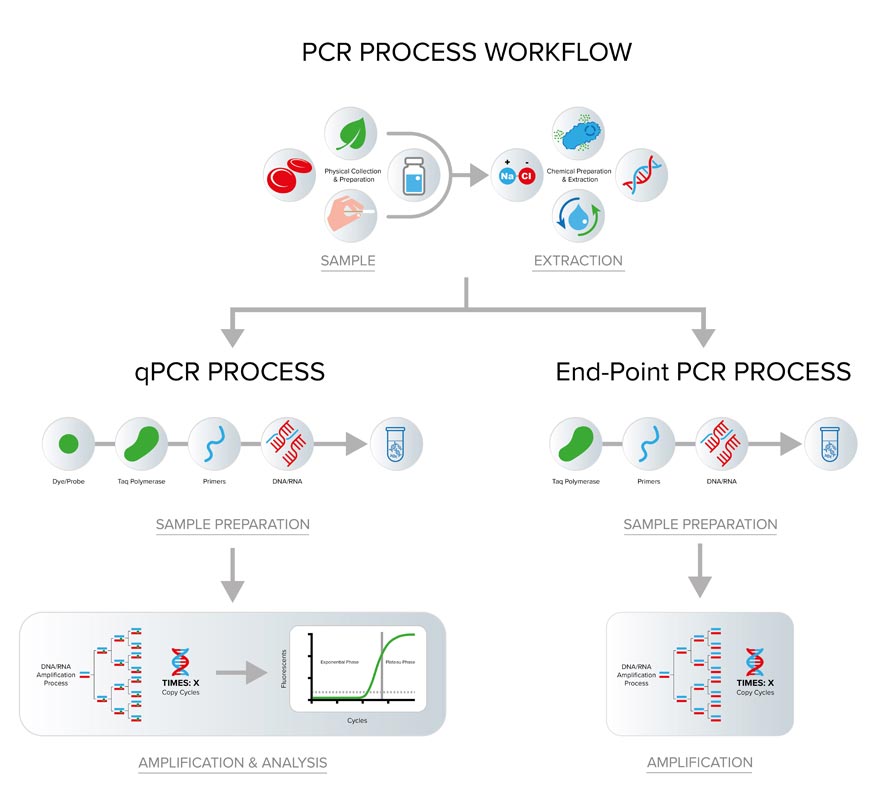
At its core, conventional PCR relies on enzymatic DNA replication driven by temperature cycling. The reaction mimics natural DNA synthesis but does so in a controlled, cyclic manner.
Denaturation
At high temperatures (94–95 °C), double-stranded DNA melts into single strands.
This step ensures primers can access their complementary target sequences.
https://www.ncbi.nlm.nih.gov/pmc/articles/PMC2836090/
Annealing
Primers bind to specific regions of the template DNA at lower temperatures.
Annealing temperature strongly affects specificity and yield.
https://www.ncbi.nlm.nih.gov/books/NBK26852/
Extension
A thermostable DNA polymerase extends the primers, synthesizing new DNA strands.
This step is typically carried out at ~72 °C.
https://www.ncbi.nlm.nih.gov/pmc/articles/PMC3062045/
Each cycle theoretically doubles the amount of target DNA, leading to exponential amplification.
Core components of a conventional PCR reaction
A conventional PCR reaction requires only a limited number of components, yet each plays a critical role:
-
Template DNA – genomic DNA, plasmid DNA, or cDNA
-
Forward and reverse primers – define target specificity
-
dNTPs – building blocks for DNA synthesis
-
Reaction buffer – maintains optimal pH and ionic strength
-
Mg²⁺ ions – essential cofactor for DNA polymerase activity
-
Thermostable DNA polymerase – typically Taq polymerase
Detailed reagent roles are explained in NIH and academic teaching materials:
https://www.ncbi.nlm.nih.gov/books/NBK55396/
Primer design: the cornerstone of PCR success
Primer design is the single most critical determinant of PCR specificity and performance.
Key primer design principles include:
-
length of 18–25 nucleotides
-
GC content of 40–60%
-
similar melting temperatures (Tm) for primer pairs
-
avoidance of hairpins, dimers, and repeats
Widely used academic primer design tools and guidelines include:
Good primer design reduces non-specific amplification and improves reproducibility.

PCR optimization strategies in routine laboratories
Although conventional PCR is robust, optimization is often required, especially when working with complex templates.
Common optimization parameters include:
-
Annealing temperature gradients
-
Mg²⁺ concentration adjustments
-
Template DNA input range
-
Cycle number optimization
University core facility manuals provide structured optimization workflows:
https://www.ncbi.nlm.nih.gov/pmc/articles/PMC4478221/
Optimization is particularly important for low-copy targets, GC-rich regions, and environmental or crude samples.
Detection of PCR products by agarose gel electrophoresis
Unlike real-time PCR, conventional PCR is detected after amplification is complete. Agarose gel electrophoresis is the most common detection method.
Workflow overview:
-
Agarose gel preparation
-
Sample loading with DNA ladder
-
Electrophoretic separation
-
Visualization using DNA stains
Educational explanations of gel electrophoresis are available from NIH and OpenStax:
Gel electrophoresis provides qualitative information such as amplicon size and presence/absence.
Laboratory controls and contamination prevention
Because PCR can amplify extremely small amounts of DNA, contamination control is essential.
Standard best practices include:
-
no-template controls (NTC)
-
positive amplification controls
-
physical separation of pre- and post-PCR areas
-
filtered pipette tips
CDC laboratory training materials outline contamination control strategies applicable to PCR workflows:
https://www.cdc.gov/labtraining/training-courses/pcr.html
Common laboratory applications of conventional PCR
Clone screening and plasmid verification
PCR is routinely used to confirm the presence, size, and orientation of cloned inserts.
https://www.ncbi.nlm.nih.gov/books/NBK55396/
Genotyping and genetic screening
Conventional PCR enables detection of specific alleles, deletions, or insertions in research models.
https://www.ncbi.nlm.nih.gov/pmc/articles/PMC7141722/
Environmental and microbiological studies
PCR is widely used for qualitative detection of microbial DNA in environmental samples.
https://www.ncbi.nlm.nih.gov/pmc/articles/PMC5452224/
Method development and assay feasibility testing
Before transitioning to qPCR or sequencing, conventional PCR is often used to verify primer performance and target accessibility.
Limitations of conventional PCR
Despite its strengths, conventional PCR has limitations:
-
endpoint (non-quantitative) detection
-
limited dynamic range
-
dependence on gel-based interpretation
Comparative method reviews highlight where conventional PCR fits relative to qPCR and dPCR:
https://www.ncbi.nlm.nih.gov/pmc/articles/PMC7141722/
In many laboratories, conventional PCR serves as a screening or confirmation tool, rather than a final quantitative method.
This article aligns with high-intent laboratory search terms such as:
-
conventional PCR
-
PCR amplification technique
-
endpoint PCR analysis
-
DNA amplification laboratory method
-
PCR gel electrophoresis
-
qualitative PCR assay
Practical role of a Conventional PCR product in laboratories
A Conventional PCR product supports:
-
routine DNA amplification
-
educational and training laboratories
-
early-stage research workflows
-
cloning and verification tasks
Its value lies in simplicity, reliability, and broad applicability, making it a staple across molecular biology labs worldwide.
Key educational and government references (.edu / .gov)
-
NIH – PCR fundamentals
https://www.ncbi.nlm.nih.gov/books/NBK26850/ -
Genome.gov – PCR overview
https://www.genome.gov/about-genomics/fact-sheets/Polymerase-Chain-Reaction-Fact-Sheet -
CDC – PCR laboratory practices
https://www.cdc.gov/labtraining/training-courses/pcr.html -
OpenStax – Microbiology PCR chapters
https://openstax.org/details/books/microbiology -
MIT – Primer design guidelines
https://biology.mit.edu/research/primer-design-guidelines/