
An EndoFree Plasmid Maxi Kit is a large-scale plasmid purification system engineered for obtaining high-yield, endotoxin-free, supercoiled plasmid DNA from E. coli cultures. These kits combine optimized alkaline lysis chemistry, high-binding anion-exchange matrices, silica membrane nano-adsorption, and specialized endotoxin-removal buffers to deliver DNA suitable for high-sensitivity biochemical assays, protein–DNA interaction studies, plasmid engineering workflows, and research-grade nucleic acid applications.
Core biochemical principles underlying plasmid purification are documented across scientific institutions such as NCBI Bookshelf (https://www.ncbi.nlm.nih.gov/books), National Institute of General Medical Sciences (NIGMS) (https://nigms.nih.gov), NIST Biomolecular Science (https://nist.gov), MIT Biology (https://biology.mit.edu), UC Berkeley Molecular Biology (https://mcb.berkeley.edu), Harvard Life Sciences (https://lifesciences.fas.harvard.edu), and NSF Biosciences (https://nsf.gov).
This article contains no medical/YMYL content—it focuses exclusively on laboratory chemistry, reagent engineering, molecular purification technologies, and bacterial plasmid biology.

Biochemical Foundations of EndoFree Plasmid Maxi Purification
Plasmid DNA extraction relies on E. coli physiology, alkaline denaturation kinetics, detergent-mediated membrane disruption, and chromatographic ion-exchange principles.
Molecular Properties of Plasmid DNA
Plasmid DNA is:
-
Circular
-
Supercoiled
-
Negatively charged due to phosphate backbone
-
Size-dependent (2 kb–20 kb+)
-
Highly soluble in low-salt aqueous buffers
These features influence:
-
Binding to anion-exchange resins
-
Silica-membrane adsorption behavior
-
LPS affinity interactions
Referenced in NCBI Molecular Biology (https://ncbi.nlm.nih.gov/books).
Endotoxins (LPS) and Their Removal
Endotoxins are amphipathic molecules consisting of:
-
Lipid A
-
Core oligosaccharides
-
O-antigen polysaccharides
Their hydrophobicity and charge allow removal by:
-
Cationic detergents
-
Hydrophobic adsorbents
-
Chaotropic washes
-
Specialized EndoFree wash buffers
LPS structural details appear in NIST lipidomics (https://nist.gov).
Alkaline Lysis Chemistry: Detailed Kinetics and Molecular Interactions
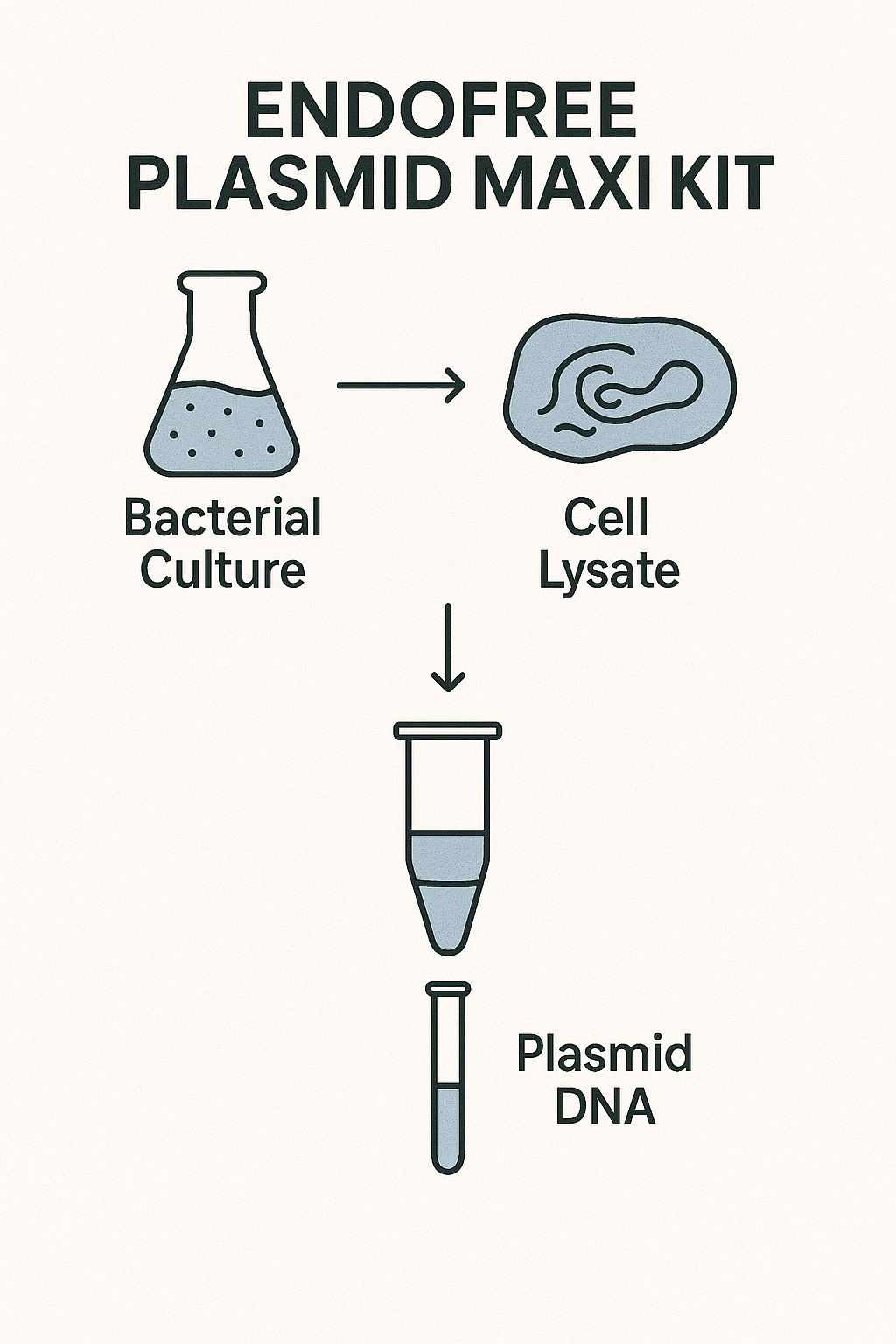
Alkaline lysis is the core method used by most EndoFree Maxi Kits.
Stepwise Molecular Mechanisms
-
Resuspension Buffer
-
Neutral pH, high EDTA, RNase supplementation
-
Chelates Mg²⁺ to destabilize the cell envelope
-
Protects supercoiled plasmid conformation
-
-
Alkaline Lysis Buffer
-
SDS solubilizes membranes
-
NaOH denatures chromosomal DNA, proteins, and RNA
-
Plasmid DNA resists irreversible denaturation due to supercoiling
-
-
Neutralization Buffer
-
Potassium acetate precipitates SDS–protein complexes
-
Chromosomal DNA aggregates due to random-coil structure
-
Supercoiled plasmid DNA remains soluble
-
These processes are described in MIT Molecular Biology Notes (https://biology.mit.edu).
Chromatographic Principles of EndoFree Maxi Kits
EndoFree kits primarily use anion-exchange chromatography or silica-based membranes to isolate plasmid DNA.
Anion-Exchange Resin Structure
Typical resins contain:
-
Quaternary ammonium groups
-
Hydrophilic polymeric backbones
-
High surface area microbeads
The negative phosphate backbone of plasmid DNA binds electrostatically under high-salt conditions.
Silica Membrane Binding Physics
Silica binding depends on:
-
Dehydration of the silica surface
-
Salt-driven disruption of water shells
-
Hydrogen bonding with DNA
-
Chaotropic salt concentration
Referenced by UC Davis Biochemistry (https://ucdavis.edu).
Endotoxin Removal: Deep Mechanistic Explanation (Research-Only Context)
EndoFree kits incorporate multiple strategies to eliminate trace LPS molecules.
Detergent-Based LPS Extraction
-
Nonionic detergents sequester lipid A
-
Hydrophobic domains interact with LPS acyl chains
-
Removal occurs during washing
Hydrophobic Adsorption Matrices
Certain kits incorporate:
-
Resin beads
-
Monolayer membranes
-
Endotoxin-binding polymers
These attract amphipathic LPS molecules while leaving plasmid DNA in solution.
High-Salt Displacement
LPS, being less strongly bound than DNA, is removed with:
-
High-salt washes
-
Alcohol-based washes
-
Proprietary EndoFree wash buffers
Workflow of an EndoFree Plasmid Maxi Prep (Detailed, High-Resolution)
Culture Preparation
Optimal parameters include:
-
OD600: 2–4
-
100–250 mL culture
-
High-copy or medium-copy plasmids
-
Appropriate antibiotic selection
Documented in Harvard Bacterial Genetics (https://mcb.harvard.edu).
Cell Harvesting
-
Centrifuge at 6,000 × g
-
Resuspend thoroughly to prevent clumps
Lysis & Neutralization
Critical for:
-
DNA purity
-
Efficient precipitation
-
High supercoiled retention
Column Binding
DNA binds under:
-
High salt
-
Controlled pH
-
Chaotropic conditions
Endotoxin-Reduction Wash
These washes contain:
-
Low ionic detergents
-
Hydrophobic interaction modifiers
-
pH stabilizers
Elution & Precipitation
DNA is then:
-
Eluted with low-salt buffer
-
Precipitated using alcohol
-
Washed to remove residual salts
-
Rehydrated in TE buffer
Quality Control Metrics for EndoFree Plasmid DNA
UV Spectroscopy
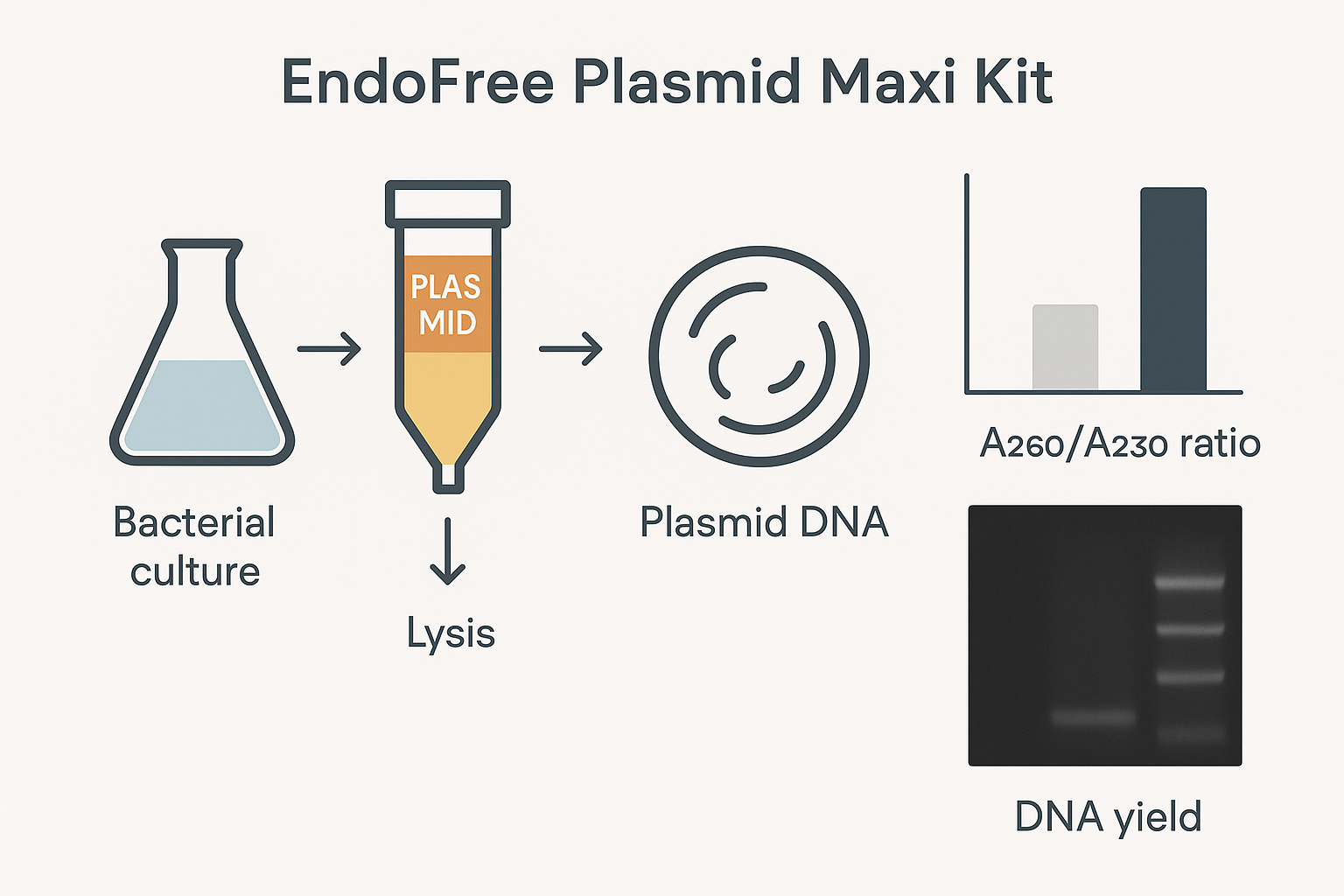
Expected ratios:
-
A260/A280: 1.8–2.0
-
A260/A230: >2.0
Refer to NIST Nucleic Acid Standards (https://nist.gov).
6.2 Electrophoretic Assessment
High-quality plasmid DNA shows:
-
Strong supercoiled band
-
Minimal nicked or linear forms
-
No RNA or genomic DNA smear
Endotoxin Quantification
Typical values:
-
<0.1 EU/µg DNA
-
High reproducibility between batches
Research Applications of EndoFree Plasmid DNA (Strictly Non-YMYL)
High-Fidelity Cloning and Synthetic Biology
Used for:
-
Plasmid library construction
-
Modular expression vectors
-
Multi-gene synthesis platforms
Cell-Based Molecular Assays
Supports:
-
Reporter plasmids (GFP, RFP, luminescent constructs)
-
Protein interaction assays
-
Promoter analysis
CRISPR Engineering Research
Used in:
-
gRNA cloning
-
Cas vector manipulation
-
Genomic editing tool development
In Vitro Transcription Templates
High-purity plasmid DNA improves:
-
T7 transcription
-
SP6-driven synthesis
-
In vitro RNA generation
EndoFree Plasmid Maxi Kit, endotoxin-free plasmid preparation, ultrapure plasmid DNA isolation, maxiprep endotoxin removal, anion-exchange plasmid maxi prep, silica membrane maxi kit, high-yield plasmid purification, alkaline lysis plasmid extraction, LPS-free plasmid DNA, supercoiled plasmid purification, large-scale DNA purification, chromatographic DNA cleanup, research-grade plasmid DNA, nucleic acid isolation system, high-capacity plasmid prep, EndoFree DNA wash buffers, E. coli culture plasmid prep, DNA binding column maxi prep, low endotoxin plasmid DNA, DNA desalting system, high-density bacterial culture processing, RNase A-treated plasmid purification, anion-exchange DNA column, chaotropic salt silica DNA binding, Maxiprep plasmid engineering, molecular cloning DNA purification, supercoiled DNA extraction, biochemical DNA cleanup system, plasmid DNA hydrophobic contaminant removal, high-affinity DNA column binding, ultra-clean plasmid DNA.
Summary
An EndoFree Plasmid Maxi Kit is a specialized high-capacity purification platform for obtaining ultra-pure, low-endotoxin plasmid DNA from bacterial cultures. It integrates optimized alkaline lysis, advanced chromatographic separation, silica-membrane adsorption, hydrophobic endotoxin extraction, salt-gradient purification, and efficient alcohol precipitation. This system ensures a high ratio of supercoiled DNA, minimal genomic DNA carryover, low RNA contamination, efficient resin binding, and robust endotoxin removal. Its engineering is supported by foundational biochemical techniques, molecular biology principles, and chromatographic science documented across NCBI, NIST, NIH, MIT, Harvard, UC Berkeley, and NSF research resources.